Evaluations for learning
September 23, 2013 § Leave a comment
I was delighted to discover that USAID has included in its online Learning Lab a paper I wrote back in 2008, Evaluations for Learning.
Aimed at managers, commissioners and funders within the UK statutory and voluntary sectors, the paper explores the potential of evaluation as a tool for organisational learning and development. I compare conventional evaluations and evaluations for learning, offer notes for commissioners of evaluations, and conclude with some questions for development.
Thanks to my former Framework colleague Bruce Britton for bringing the link to my notice.
Proof positive
September 22, 2013 § Leave a comment
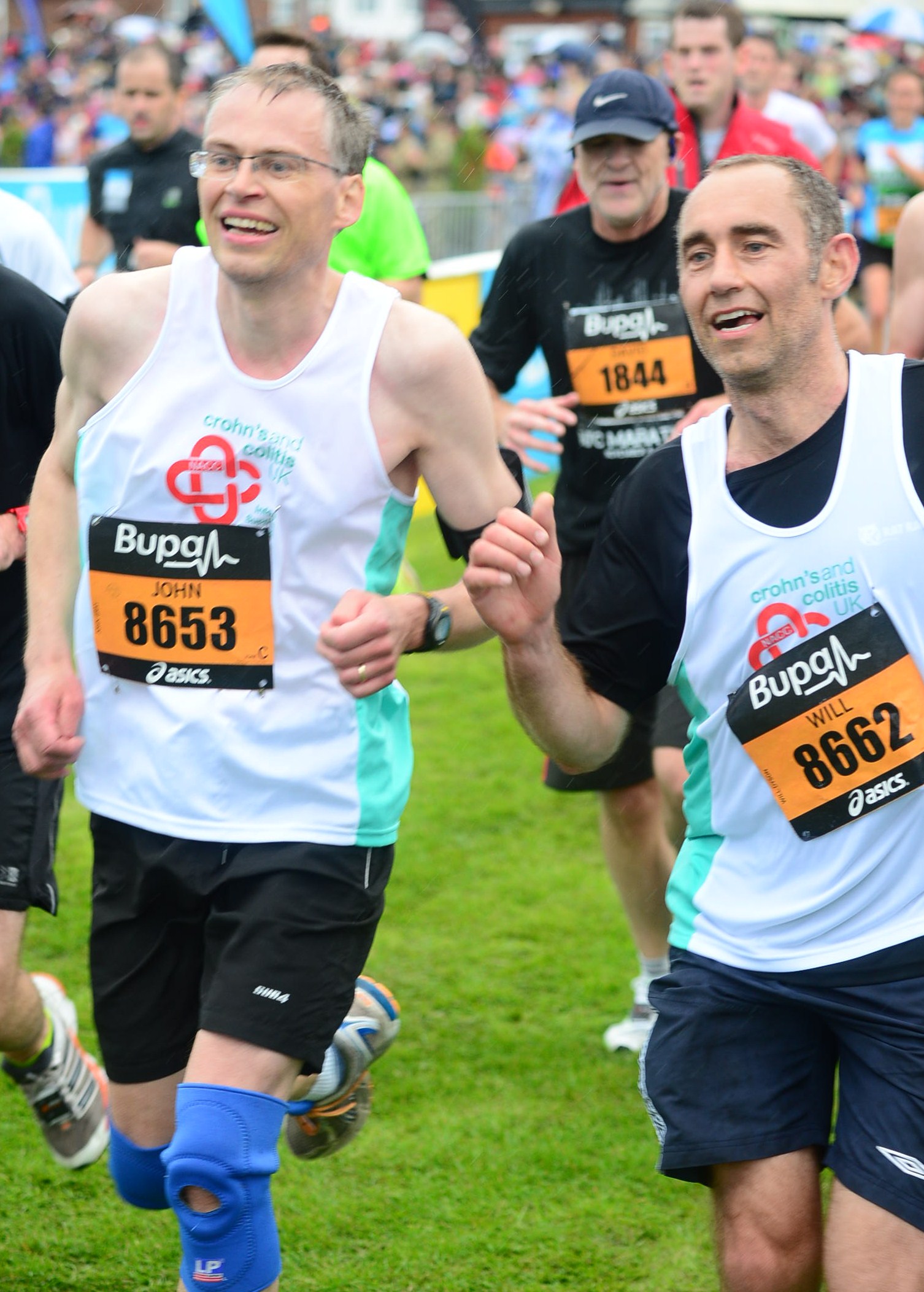
Thank you for supporting / sponsoring me for Sunday’s Great North Run. The photo is from the last few yards as we made it for the line.
The weather wasn’t great at times, but once the starting gun went, the enjoyment of the race took over. I don’t think I’ll ever forget the thrill of being in the same race as Mo Farah (not that I even saw him); and that the race was of such significance for both women’s and men’s distance elite running. The stage is set for their showdowns at the London Marathon next year http://www.theguardian.com/sport/2013/sep/15/mo-farah-great-north-run
As for Will and me, we managed to stick alongside each other amidst the crowds of runners, and finished in 1 hour 40 minutes – some 40 minutes after Mo. I’d do it all again, no question. We had a great time together, and I wouldn’t have run as fast as I did without him. Thanks too to the team from Crohn’s and Colitis UK – the cups of tea in the hospitality tent afterwards were very welcome, and we enjoyed exchanging race stories with some of the other 200 racers running yesterday for Crohn’s and Colitis.
PS
There was a hilarious “It’ll Be All Right On The Night” moment from the race highlights on the BBC:
TV interviewer to one of the runners she’d picked out of the race: Are you hoping for a good time?
Runner: Sounds good, what are you offering?
Learning from my own resilience
September 16, 2013 § Leave a comment
Building on my previous post on resilience, I want to look at community resilience from the viewpoint of what I know about my own personal resilience.
My working definition of community resilience as the ability of a group of people sharing a geographical or other identity to manage, respond to and emerge from community-wide shocks or suffering.
If I reflect on my own resilience, my thoughts are:
My capacity for resilience fluctuates – in other words, it’s not something like, say, a hammer which once bought is pretty much always there, unchanging and available as needed.
I need others sometimes to help me find my resilience. One way of doing this is for me to watch when they are in my eyes acting resiliently, and to seek inspiration in their behaviour.
I can act in a resilient way even if I don’t feel very resilient. Is this just a deeper layer of resilience, which I need at times to dig deep for? In any event, at times I am like a bumblebee: science may say I can’t fly, but I sometimes I can fly only because I think I can.
For me, my resilience is fundamentally a mental rather than a physical quality. Physical well-being and exercise play their part in nurturing resilience. But it feels more that my resilience is about my will and belief to keep going regardless of my physical condition. And as part of my resilience relates to my Crohn’s Disease (an inflammatory bowel disease), the ability to find courage, strength and persistence in times of less-ability is crucial.
Again for me, my resilience to keep going is linked to my values and my beliefs. Resilience gives me courage to work for things in the future because they seem worthwhile to strive for, not necessarily because they have a good chance of succeeding.
***
If I take this into communities, perhaps the following might be helpful comparators:
If my own resilience fluctuates, my guess is that that’s true for others and on a bigger scale when applied to members of a community. This probably makes it all the harder to predict how a community may react, or to be confident in the durability of any one-off assessment of the community’s resilience.
Community members can act as inspirations for each other, enabling them to take steps they wouldn’t normally take (this can lead to negative as well as positive behaviours, of course).
And one way for community members to build resilience is by getting to know each other, building relationships and getting through tougher times together.
I finished the previous blog by wondering if resilience was about ordinary people, doing extraordinary things in extraordinary times. I might now add that they are relying on relationships created in ordinary times but which stand firm in extraordinary times.
Help! I’m running against Mo Farah this Sunday…
September 9, 2013 § Leave a comment
Resilience: ordinary people in extraordinary times, doing extraordinary things
September 9, 2013 § 2 Comments
I have been invited to a round-table on the theme of Resilience, taking place later this month. Though our focus will include building resilient Quaker communities up and down the country, the invitation has prompted me to think about resilience generally.
What is resilience in a community context? How can one diagnose the strength of a community’s resilience? And, how can resilience be encouraged?
This post is a record of my early thinking, and there is much out there on the subject already, so I’m not claiming any new learning. I would be very interested in any responses, or any useful resources you know about, and I’ll share here what people suggest to me.
Resilience seems relevant to a great range of events which have their impact locally. To name a few:
- climate change
- the ending of local industries or other significant employers
- the local impact of national financial austerity or economic downturn
- freak weather events
- pandemics
- corporate invasion, such as mining or fracking companies – see The Pipe for a great documentary example (www.thepipethefilm.com)
- the threat of violence, or actual violence – whether from within or from external sources
- high population churn, or the arrival of new residents into a previously settled community.
What is resilience?
The dictionary of course is a great place to start. Its entries on resilience gave me two ways in which resilience can be looked at. The perhaps more familiar understanding is resilience as the ability to withstand shock, suffering or disappointment. From a physical point of view, however, resilience is the ability of a substance to recover its form and position elastically. I like the image of that elastic rebounding, back into shape after managing a challenge.
So I take community resilience as the ability of a group of people sharing a geographical or other identity to manage, respond to and emerge from community-wide shocks or suffering. The sense is of a community ‘bouncing back’ – though unlike a piece of elastic, a community is likely to bounce into a different shape than it was before, with changes to relationships and probably some people in a place of greater or lesser resilience than before.
There must also be a link to the comparative fragility or strength of a community – if it was weak before, my assumption is that it will find it harder to respond to shocks. There will be communities that are resilient in anticipation of shocks; and there will be communities that develop resilience only once a shock or traumatic incident arises.
And before I get too far along this journey, I need to affirm that communities are made up of people; and so resilience – or its absence – will be expressed in what people think and believe, what they feel, and what they do. A community responding to a shock, will be demonstrating a network of human stories – with examples of altruism and generosity alongside moments of selfishness and aggression.
Can we then measure how resilient a community may be?
CarnegieUK Trust and the Fiery Spirits Community of Practice in 2009 published Exploring Community Resilience in Times of Rapid Change. It has a simple model which leaps off the page for me. It identifies four dimensions of community resilience building, in which “work in one area is likely to benefit and amplify that in another”. It also works as a diagnostic tool: how far do we assess our community as having:
- Healthy people: supporting individuals’ physical and psychological well-being;
- An inclusive, creative culture: generating a positive, welcoming sense of place;
- A localised economy – within ecological limits: securing entrepreneurial community stewardship of local assets and institutions.
- Cross-community links: fostering supportive connections between inter-dependent communities.
If this model is taken at face value – and there must be many similar versions, highlighting different aspects of communities and of resilience – then we also have a model of starting points for the ‘how’ of community resilience building. I’m sure there is much more for me to learn about the how; and what of the many efforts in resilience-building around the world can be replicated or adapted.
I wonder how many examples of resilient communities are in essence the coincidental combination of ordinary people, in extraordinary times, doing extraordinary things.
NB This is the first of four posts on the Resilience theme: click the Resilience tag in the right hand margin to see the other posts.
News from Newcastle – the impact of the cuts on communities
July 3, 2013 § Leave a comment
Newcastle Conflict Resolution Network, with whom I’ve had the privilege of working with over several years (facilitation, Management Group support and development, and carrying out an evaluation), has just published their latest Newsletter which I recommend to you.
In particular it looks at the impact of cuts and of the bedroom tax on communities – forced moves, reduction of services for young people, greater community divisions, and an increase in crime – especially shoplifting, and not theft of valuable electronic goods: nowadays it’s meat and baby foods.
Their newsletter also includes news of their projects to support constructive community building and capacity for conflict resolution amongst Newcastle’s residents and agencies.
Supervision skills training for mediator supervisors
June 26, 2013 § Leave a comment
Bookings are coming in nicely for Manchester 11 July and Wandsworth 19 July.
And thank you Katherine Stoessel for this testimonial from when the programme ran previously:
“This course was invaluable in terms of building my confidence and increasing and developing the particular qualities and skills I needed in order to fulfil my new role. I was particularly impressed with the sensitivity and knowledge that John brought to his role as facilitator and the way he supported each participant to find their own voice.”
Tackling tough issues and working with hope
June 21, 2013 § Leave a comment
There’s no doubt of the value of people across diverse or divided communities, being able to reach out to each other, challenge myths and prejudices, and find ways of building local resilience.
Are you involved in, or interested in supporting this “good relations” work?
My friends/colleagues at http://www.talkforachange.org.uk, together with International Alert, and funded by the Joseph Rowntree Charitable Trust, are running a series of regional meetings for practitioners and managers.
Starting next week, the events will explore setting up a national coalition of good relations organisations which could improve the voice, practice and visibility of good relations work in England. The events will include the chance to discuss local divisive narratives and how you are currently tackling them, and impact measurement.
My connection to this is that Talk for a Change and I are in conversation about how to establish rigorous and realistic impact assessment models for community dialogue and facilitation. And in my consultancy work with the Newcastle Conflict Resolution Network, and in shaping co-design processes for patients and clinical staff, I’m interested in how those who wouldn’t normally talk to each other, can find ways of hearing each other’s voices and build a culture of greater understanding and empathy.
Details of the Talk for a Change regional meetings are here. Organised so far:
24th June in Stockwell, London
27th June in Manchester
2nd July in Warrington
15th July in Newcastle
11th September in Leeds
With other regions to be planned.
Training dates announced
June 17, 2013 § Leave a comment
After a break of several years, my Supervision Skills course for supervisors of mediators is now running again as an open programme.
The dates are:
11 July, Manchester
19 July, London
This one-day programme – the training course I most enjoy delivering! – is accredited by the College of Mediators (6 CPD points).
The programme is for those new to supervision or who are anticipating a move into a supervisory role – staff or Board members, and volunteer mediators who are taking on an additional role within their service.
The programme is aimed at practitioners across the mediation sector, including family, neighbour, inter-generational, restorative justice, schools and workplace mediation.
Course fee: £110. Discounts available for multiple bookings from the same service.
For more information and details of how to reserve your place, see the following brochures:
Your goals: for performance or learning? Concrete, or more abstract?
May 29, 2013 § 2 Comments
Do you prefer your goals to be about learning or about performance? And phrased in concrete terms, or more abstract?
Setting goals is inherent in our culture and in our practice – whether they’re an organisation’s mission aims and objectives, or how we manage ourselves through the to-do list each day.
From my own experience, I know that both short- and long-term goals can inspire me into effective action; but they don’t always work.
So I enjoyed very much a recent lecture for the Quakers and Business network, David Megginson, Emeritus Professor of Human Resource Development, Sheffield Hallam University. He shared some interesting emerging evidence, that goals in themselves may be unhelpful in certain situations; and that different kinds of goals may suit different temperaments [1].
For example, goals may be unnecessarily limiting if they are too specific, carry too heavy a penalty for failure (in organisational terms, or for my own self-esteem), or if I don’t have a say in defining them, such as a goal given to me by my manager, or if it is an organisation-wide goal inappropriately translated for my own work priorities) [2]. I meet goals like this sometimes in my coaching practice, if someone has been ‘told’ to come to coaching to remedy apparent defects in performance.
So to the questions in the title of this piece. If you think about a goal or a hope you set yourself recently, how does it fit these categories:
- Was it a goal which could be reached in time or achievement (proximal) or further ahead in the future (distant)?
- Was it a concrete, specific goal; or was it phrased in more abstract terms?
- Do you see yourself as approaching your goal (“The ideal livelihood I want is…”); or is the goal phrased as avoidance (“I want to overcome feeling underconfident when I’m meeting the Board”)
- Are your goals about performance (How do I…); or are they about learning? [3]
You may find that goals of a specific type work for you more times than not – for example, goals that are distant, concrete, which approach an desired outcome and which are about performance.
Or you may find that different types work for you in different situations – between personal or professional goals; or goals for daily achievements alongside a longer-term hoped-for change.
One other factor also to take a moment to think about.
If you have consciously used goals in the past, what has been your experience? Did they work; or not? (remember that goals that work may lead to effective action and valued outcomes, even if they were not the intended outcomes).
And in addition to whether goals have worked for you in the past, Professor Megginson has identified some other factors which influence our progress towards our own goals:
- How strong is my motivation – how important to me is achieving this goal?
- How good is my contextual awareness: how accurate is my picture of external factors that may help or hinder achievement?
- Is this goal mine? Who shares it with me or has a stake in its outcome?
- Do I believe that I can see, feel or touch the outcome?
- Will I be able to measure or assess the outcome?
- Is the goal aligned with my personal values: does it have inner “sense of rightness”?
I am finding it helpful to critique my own goals in the light of my own learning about what kinds of goals work best for me; and finding – as I believe it does for my coaching clients – greater commitment to the right kind of goals in both professional and personal contexts.
[1] See Susan David, David Clutterbuck & David Megginson, Beyond goals, 2013, Aldershot, Gower (forthcoming).
[2] Ordóñez, L.D., Schweitzer, M.E., Galinsky, A.E., Bazerman, M.H. (2009). Goals gone wild: The systemic side- effects of overprescribing goal setting, Academy of Management Perspectives, February,6-16
[3] Grant, A.M. (2007). When own goals are a winner. Coaching at Work, 2(2), 32-35.
 John Gray
