Accredited Supervision Skills training, Edinburgh
June 26, 2014 § Leave a comment
Scottish Mediation Network have commissioned me to deliver this two-day programme to further SMN’s objective of promoting quality assurance in mediation, and towards developing a register of accredited mediation supervisors as part of a specified competency framework.
For freelance supervisors and those working or volunteering as supervisors within mediation services – whether in Scotland or elsewhere.
Download the course flyer.
22 and 23 September 2014, Edinburgh.
£240, SMN members £220.
Accredited by the College of Mediators (12 CPD points).
To book, contact carol@scottishmediation.org.uk or call 0131 556 1221.
Quakers, Slavery and Climate Change
June 18, 2014 § Leave a comment
I’m speaking in York on Monday 21 July.
Quakers, Slavery and Climate Change
Learning from 18th Century American Friends’ journey to abolitionism: parallels for our responses to climate change
This is as a result of some personal research I’ve been doing over the last couple of years. My aim has been to examine how an organisation and its communities made a fundamental internal change over an issue which every member was connected to, directly or simply as a citizen of a society in which slavery was embedded. I hope that there is enough similarity between the two contexts to draw some useable suggestions for approaches and ways forward, today, in responding to climate change.
Chaired by Danielle Walker, Director, Friends Provident Foundation
Monday 21 July, 7.30 pm, Friargate Quaker Meeting House, Friargate, York, YO1 9RL
Copy of my paper here: Quakers, Slavery and Climate Change.
Contact me for more information or to respond to the paper: 07986 016804, john@johngray.org.uk
UK news – new domain names available for organisations
June 16, 2014 § Leave a comment
The new domain names means that websites can be registered without needing a .org.uk or .co.uk or other familiar ending.
Instead, more creative names are available – .guitars, .careers, .today, .solutions… You can see a full list of the names released so far here http://ariotek.co.uk/domainchecker.php
The following is extracted from my domain name host, ariotek.co.uk (other providers are available!).
“2014 will see a huge change in the way domain names are used to navigate the net. The old favourites and common domain extensions .com .net .org will soon become a thing of the past. New premium domain extensions, search engine optimised, specifically targeted to your industry or to the content of your site will soon become the new norm.
During the next 18 months these industry specific premium domain name extensions will slowly be released for general availability.
General availability means that anyone can register any of these new domains on a first come first served basis, apart from trademark infringement there are no other limitations. If you have a business name or a product you want to keep locked down then it is worthwhile considering buying your ideal premium domain extension while they are still very new to the open market.
As an example … “.kitchen” is one of the new domain extensions now available on General availability. If you search on Google.com there are literally hundreds of restaurants and takeaways worldwide called.. “Simonskitchen” yet… only one of these businesses can register the premium domain that is perfect for any one of them “simons.kitchen”. If you owned one of the simonskitchen businesses would you want to buy that domain? I know I would, as fast as I possibly could! Once it’s gone it’s gone.
So far there are 80 new domain name extensions released to general availability with another 585 (That’s not a typo!!) confirmed and still to be released. These new domain name extensions cover a vast range of possibilities .bargains, .club, .gallery, .kitchen, .tattoo for example with many many more in between. A full list of the currently available new premium domain extensions are listed on the domain checker page on our site here http://ariotek.co.uk/domainchecker.php.
To add to the new domain extensions, Nominet the controller of UK domain names has released the new .UK domain under limited availability. If you own a .co.uk domain you now have the full rights to register the .UK version of that domain. You cannot register a .UK domain if you do not own the .co.uk version until all .UK domains become available to register without limitations which will not happen until June 10th 2019.”
Places available: Leading and Managing Effective Human Rights Organisations
April 4, 2014 § Leave a comment
I am thrilled to be convening a forthcoming online module on Leading and Managing Effective Human Rights Organisations. The module is part of a Post-Graduate Certificate offered by the Centre for Applied Human Rights at the University of York.
The module runs for ten weeks, beginning on 23 April 2014. Some scholarships may be available for non-OECD participants – click here for information.
The module will address the theory and practice of leading and managing in the human rights context, with the emphasis on effective leadership and management.
So the module’s topics include Leading others, leading yourself; Strategic planning and leadership; Creativity, innovation and the learning organisation; Governance and accountability; Organisational development and change; Programme and project management; Performance management; Fundraising and financial monitoring systems; and Globally Responsible Practice.
Sounds like a course for you, or for someone you know?
Places are still available on the programme, and it is possible to enrol for an individual module as a CPD student and without taking the whole Post-Graduate Certificate. For the current academic year 2013/14, tuition fees for each module are £420.
Click here for information on how to apply.
I am really looking forward to the course, and to the engagement with human rights practitioners from around the world.
Quakers, Slavery and Climate Change
February 11, 2014 § Leave a comment
I’ve been looking at how American Quakers changed from condoning slavery, and some Quakers being slave-owners or slave-traders, to in 1758 making slave trading an enforceable breach of Quaker discipline. I was inspired by a quote from Bill McKibben: “Since all of us are beneficiaries of cheap fossil fuel, tackling climate change has been like trying to build a movement against yourself – it’s as if the gay-rights movement had to be constructed entirely from evangelical preachers, or the abolition movement from slaveholders.” [1] (my emphasis)
Training courses for 2014
December 19, 2013 § Leave a comment
This year has seen a very successful return of open supervision skills training courses – programmes ran in Manchester, Edinburgh and London. I also ran a workshop at the Midlands Mediation Network in early December.
Here’s a flavour of the feedback:
- I felt comfortable to share my views with the rest of the group which I don’t normally feel able to do; so I was definitely more vocal and this was down to John’s training style and relaxed atmosphere. Brilliant!
- [It put] depth to the structure I already have in place, to make the process more meaningful and productive for all involved.
- A very well thought out day with a great mixture of learning tools.
- This was excellent. John brings so much wisdom, respect, balance and thoughtfulness to the training. Just about as good as it gets!
And from a post-course e-mail:
“I gained a great deal from the day and loved the way in which you managed the needs of us all so calmly and peacefully (a strange word to use for this purpose, but that’s the environment which you created). The way in which you gave us info – instead of the usual constant brainstorming and discussion to get to the same result but more slowly(!) – was much appreciated and has enabled me to focus on key issues which I will need to raise with the Trustees of Mediation Bucks when we continue discussions about how I will work with them as a supervisor – thank you.” Jackie Miller.
Here are my plans for training in the coming year – expressions of interest welcome, so that I can keep you informed:
- Supervision skills either the Midlands or the South-West, depending on interest; in London; and in Edinburgh or Glasgow
- An advanced supervision course, for those who want to really deepen their practice; likely to be in London and Edinburgh or Glasgow
- Reflective Practice
- Innovation and creativity for leaders, managers and practitioners
All these courses will carry CPD points, accredited by the College of Mediators
E-mail to register your interest, especially if you want to influence the location of any of these courses; and sign-up to this blog, as details of all courses in 2014 will be promoted here.
Training dates announced
November 4, 2013 § 2 Comments
My Supervision Skills course for supervisors of mediators is running again as an open programme.
For more information and details of how to reserve your place, download the following brochures:
This one-day programme is accredited by the College of Mediators (6 CPD points).
Feedback from previous courses:
- “I felt comfortable to share my views with the rest of the group which I don’t normally feel able to do; so I was definitely more vocal and this was down to John’s training style and relaxed atmosphere. Brilliant!”
- “I was particularly impressed with the sensitivity and knowledge that John brought to his role as facilitator and the way he supported each participant to find their own voice.”
- “I really enjoyed the content, delivery and encouragement. I feel positive about becoming a supervisor.”
- “I feel that John is really skilled at enabling creativity and also clarity – I always feel much ‘freer’ after a coaching session.”
- “Relaxed contributions created by John made contributions easy.”
I’m really looking forward to running these programmes again; hope you can join me in London or Edinburgh.
“… a substantial multi-century climate change commitment”
October 15, 2013 § Leave a comment
I was privileged to hear Piers Forster give a talk in Leeds last week – he is one of the lead authors on the recently-published Intergovernmental Panel on Climate Change 5th Assessment Report http://www.ipcc.ch/report/ar5/#.Ul0ZkNJwq3s.
This two-size Summary for Policy Makers makes for easy reading: http://www.ipcc.ch/news_and_events/docs/ar5/ar5_wg1_headlines.pdf
From Dr Forster’s presentation, I took away the awareness that the carbon emissions to date are such that there will be little difference, regardless of the short-term steps we take, in warming in the next 30 to 40 years.
On that basis, adaptation (responding to the immediate effects of climate change on people and communities) need to be as equal a priority in the short term, as our efforts to mitigate future change.
Beyond those 30-40 years, however, the predictions change wildly based on whether we continue with business as usual or whether we can move successfully towards an economy and lifestyle low in carbon (and also low in methane and nitrous oxide emissions, two other atmospheric significant drivers).
So the more we strengthen now our capacity to mitigate future emissions, the more manageable the future will be.
The quotation in the title of this post refers to carbon emissions. The Summary for Policy Makers states:
“Cumulative emissions of CO2 largely determine global mean surface warming by the late 21st century and beyond (see Figure SPM.10). Most aspects of climate change will persist for many centuries even if emissions of CO2 are stopped. This represents a substantial multi-century climate change commitment created by past, present and future emissions of CO2.”
In short, as regards carbon emissions, the legacy of the future is already set for years to come.
But I’m also struck by the phrase “a substantial multi-century climate change commitment”.
What if that phrase was used to describe our collective response: substantial enough and relevant enough to meet the scientific and social evidence, with a two-hundred year timescale in mind, and the commitment, energy and resources to match?
Indicators for resilience
September 25, 2013 § Leave a comment
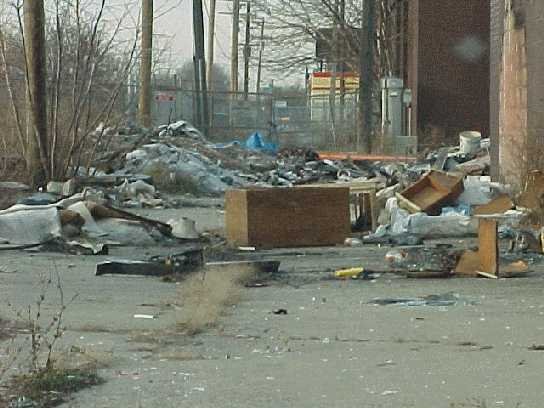 The images of the abandoned areas of Detroit are a shocking reminder of the sometimes short step between wealth and poverty, and of security and human flight.
Though the photographs show a readily recognisable non-resilient community, how easy a few years ago would have it have been to predict this community’s future? In other words, what indicators are useful in helping us assess and support resilience?
As a reminder, an indicator is an observable change or event that provides evidence that something has happened. Indicators can be set for outputs delivered, outcomes achieved and impacts observed.
In 2010 Experian produced resilience rankings comparing the potential economic vulnerability of the 12 BBC regions. Their rankings reflect each region’s strength and adaptability:
Strength of local business base: for example, is it dominated by sectors hit by the recession of those that are relatively unscathed such as agriculture, forestry and fishing, banking and insurance? Have local firms and start-ups already proven their adaptability?
Community vulnerability: for example, the percentage of households vulnerable to declines in disposable income or to long term unemployment, alongside a survey question that asked of people “Do neighbours look out for each other?”
Personal vulnerability: for example, the size of the working age population, skills, average earnings and number of professionals (managers) compared to low-skilled workers (such as labourers); and
Place: for example, median house prices, local crime rates, and green space availability.
Perhaps not surprisingly, the islands of Orkney and Shetland were amongst the top ranked areas (quoted in Exploring Community Resilience in Times of Rapid Change).
Experian’s indicators are largely economic – and certainly, they emphasise quantitative rather than qualitative assessments.
The transition movement makes a link between Energy descent action plans, and general community resilience. The Transition Handbook views “cutting carbon as one of many ‘Resilience Indicators’ that are able to show the increasing degree of resilience in the settlement in question. Others might include:
- the percentage of local trade carried out in local currency
- percentage of food consumed locally that was produced within a given radius
- ratio of car parking space to productive land use
- degree of engagement in practical Transition work by local community
- amount of traffic on local roads
- number of business owned by local people
- proportion of the community employed locally
- percentage of essential goods manufactured within a given radius
- percentage of local building materials used in new housing developments
- percentage of energy consumed in the town that has been generated by local ESCO
- amount of 16 year olds able to grow 10 different varieties of vegetable to a given degree of basic competency
- percentage of medicines prescribed locally that have been produced within a given radius.”
And the founder of the Transition movement, Rob Hopkins, argues the need for resilience indicators in his PhD thesis http://transitionculture.org/shop/localisation-and-resilience-at-the-local-level-the-case-of-transition-town-totnes/.
Exploring Community Resilience in Times of Rapid Change gives sample indicators for the four directions of people, culture, economy and community. They’re interesting partly because they are phrased according to what people might say about themselves – thus enabling the person to claim their own level of resilience.
- Healthy Engaged People: “I’m happy and fit in mind and body”
- Inclusive, creative culture: “We’re confident in our diversity – creating a great future together”
- Localised economy within ecological limits: “We steward our land, food, water, energy, services, jobs, housing”
- Cross-community links: “We collaborate with other communities near and far – we know no place can go it alone”
Indicators are “an observable change or event that provides evidence that something has happened”. The above examples may prompt your thinking for relevant indicators in the communities, individuals or organisations whose resilience you are seeking to build.
Resilience: a positive framing
September 24, 2013 § 1 Comment
In connection with the Round Table on Resilience that I am attending later this week, I have been mining the report published in 2009 by Carnegie UK Trust and the Fiery Spirits Community of Practice, Exploring Community Resilience in Times of Rapid Change.
The report draws an important distinction between emergency planning and resilience – preparing for the former is not the same as generating genuine resilience.
Indeed, there is a very positive definition of resilience, framing it positively rather than in terms of capacity to cope with shocks or disaster:
“Resilient communities intentionally develop personal and collective capacity to respond to and influence change, to sustain and renew the community and to develop new trajectories for the community’s future”. (Community Resilience: literature and practice review, Magis 2007).
Particularly thought-provoking is the report’s comment that resilience helps “future-proof’ their communities on the basis of agreed values.” Though I bridle at the jargon – and even the very concept – of ‘future-proofing’, it’s interesting to see resilience as a process of shaping and agreeing values, presumably values by which the members of the community then live.
One aspect can be easily agreed: “resilience is a ‘wicked issue’, best understood as a function of an ever changing system”. In my view, at our peril we claim to know a community’s resilience or to predict how it will respond to future challenges. Best is to draw inferences, using a range of indicators – and I want to look at indicators in the next posting.
The report has many ideas of what communities and practitioners can do to support resilience. A strong recommendation is to have fun: though sometimes urgent or deep work is needed, in most communities “most of us prefer to party with friends along the way.” Though there is a risk of flippancy here, I think it’s an important reminder to offer sociable, friendly, not-too-heavy activities as a way of supporting people and to get them to be involved.
Other activities which caught my eye:
- Experiment with asset-based approaches, such as community-led mapping, risk analysis and oral history (to build trust and common purpose)
- Exchange and learning between communities with diverse experiences of coping with – and preparing for – rapid change
- Learn skills in transforming community conflicts to better enable everyone to contribute to the bigger goal (this point links to thinking I’ve done about British Quakers’ aspiration to become a low carbon, sustainable community).
 John Gray