All the water in the world
May 24, 2012 § Leave a comment
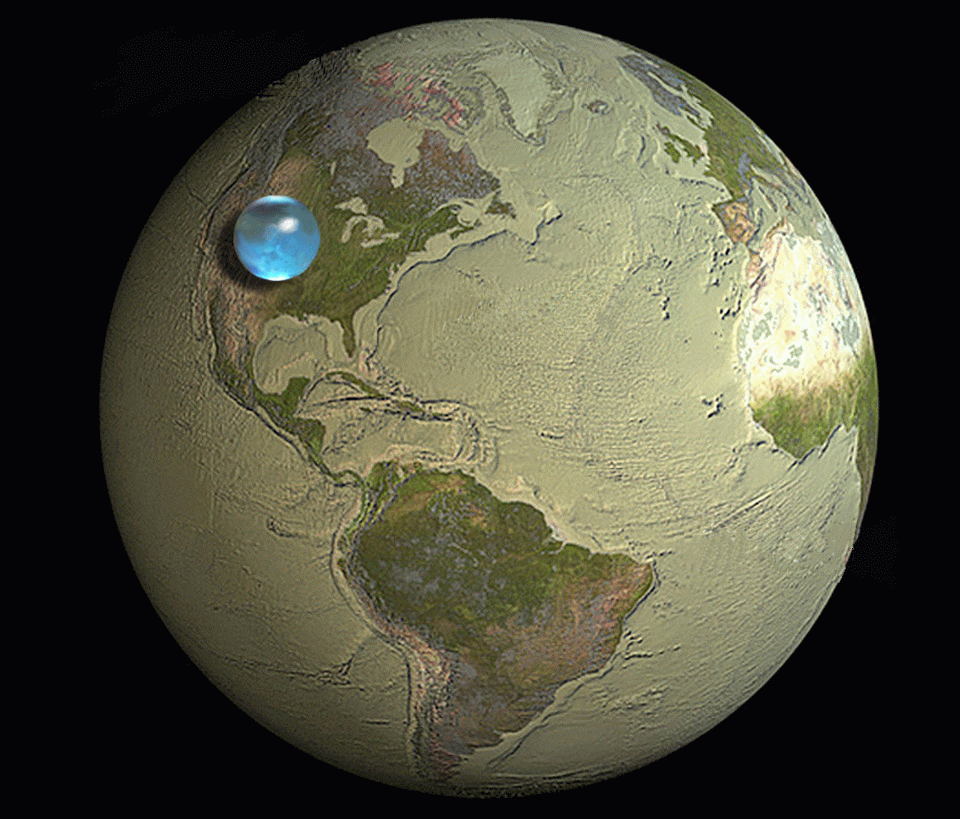 This stunning image brought home for me the preciousness of water.
We believe we are the blue planet, seven-tenths covered in water; and yet all the water collected together from the air, rivers and oceans – the water we depend on – forms this tiny droplet.
You can see the full image here.
For some this image may simply be a representation of known information in a new and surprising way; for others it might be a ‘wake up’ moment’ – in the same way that the Earthrise photograph (taken by the Apollo 11 space crew) has been dubbed the most influential environmental photograph ever taken.
Or do you remember your first reaction to this statistic: if every human being wants to live like western Europeans, we’ll need three planets to provide all the necessary resources and to cope with the waste. And make that five planets if we all want the lifestyle of North Americans.
It is known that information, on its own, is rarely enough to change behaviour. Images and statistics can sometimes help, though, in bringing a message home.
Drink of water, anyone?
Awakening Social Practice
March 26, 2012 § Leave a comment
This new programme is now open for bookings.
Together with co-facilitator and Oasis associate Chris Taylor, we will be addressing the key challenges that commercial and not-for-profit organisations are facing today: how to ensure future sustainability, growth and reputation, at the same time as becoming more globally responsible.
Key questions that participants can bring to this three-day programme:
- To what extent is it necessary to think about my organisation in terms of more than just simple (economic) survival?
- What are relevant ways in which my organisation can engage with and be effective on environmental, social and ethical issues?
- Which models and frameworks would enable my organisation to:
- Address the triple bottom line (economic sustainability, social good and the environment)
- Measure impact
- Establish effective processes for cultural and behavioural change by individuals and the organisation as a whole?
- How do I stimulate change in my organisation to engender a purpose relevant to the 21st century?
Course prospectus: Awakening social purpose; for more information contact me, or contact Oasis 01937 541700 to reserve your place.
Hope as a state of mind
March 6, 2012 § Leave a comment
Reading Vaclav Havel’s autobiography of his presidency of Czechoslovakia and then the Czech Republic, has reminded me of one of my favourite quotes – a quote that both advances my thinking and inspires me to action.
Havel wrote:
“The kind of hope I often think about (especially in situations that are particularly hopeless, such as prison) I understand above all as a state of mind, not a state of the world. We have hope within us or we don’t; it is a dimension of the soul; it’s not essentially dependent on some particular observation of the world or estimate of the situation.
Hope is not a prognostication. It is an orientation of the spirit, an orientation of the heart; it transcends the world that is immediately experienced, and is anchored somewhere beyond its horizons. Hope, in this deep and powerful sense, is not the same as joy that things are going well or willingness to invest in enterprises that are obviously headed for early success, but rather an ability to work for something because it is good, not just because it stands a chance to succeed.”
January 25, 2012 § Leave a comment
The very first programme on Consciousness Meaning and Practice took place at Oasis during the weekend 14- 15 January.
It was a weekend of firsts, as the programme also marked the initial steps of the Oasis strand in globally responsible practice (see http://www.oasishumanrelations.org.uk/blog/courses/people-and-planet-workshops).
The feedback from the January programme was most encouraging: participants were given time to reflect on and develop the sustainable self, connecting to what was most significant in their lives and how it acts as the foundation for their engagement with the world. One participant described the weekend course as a bridge – between the inner and the outer worlds; that echoes the progress of the weekend from what is the nature of my connection to people and planet, to its implications for action.
What particularly struck me was the nature of the invitation of such programmes: how to invite people to explore issues such as these without assuming anything about their inner experience. Reflecting afterwards, I think the outward simplicity of the programme freed people to take themselves where they needed to go; looking back, there were only six substantive questions over the course of the weekend. If the questions are good enough then they will lead to intersting places, and that seems to have been the outcome of the weekend. I learnt plenty myself, of course, about the role and process of the facilitator, with much more to discover as the globally repsonsible practice strand unfolds.
Two further programmes are planned, together with an exciting development now shaping for 2013:
A repetition of the January weekend: Consciousness, meaning and practice: a two-day exploration of global responsibility and the transpersonal. Dates: 29–30 September 2012
A three-day introduction to globally responsible practice and the triple bottom line, incorporating a Whole Person Learning approach. This programme is aimed specifically at those working in or with organisations. Dates: 2–4 July 2012
In 2013, Oasis will run a two-year Global Change-makers diploma. If you are interested in being kept in touch about this – or about registering on the two programmes this year, please be in touch with Samantha at Oasis: Tel: 01937 541700,samantha@oasishumanrelations.org.uk.
The work is at the level of deep complexity, and with bigger-than-self challenges exploring 21st century relationships within a global context. Those who engage will find time and space to:
- explore their current connection to and with people and planet
- raise consciousness of the connections that exist – social, transpersonal, financial, emotional and environmental
- be supported into action within their spheres of influence, with an emphasis on the spheres of work, local community action, leadership, collaboration and social innovation.
Hope is an orientation of the heart
December 19, 2011 § Leave a comment
It seems appropriate to post this quote from Vaclav Havel, who died yesterday.
It’s one of my favourite quotations, because it encourages hope for good in situations where the wisdom of the world (as opposed to the wisdom of the heart) would be advising one to surrender.
“The kind of hope I often think about (especially in situations that are particularly hopeless, such as prison) I understand above all as a state of mind, not a state of the world. We have hope within us or we don’t; it is a dimension of the soul; it’s not essentially dependent on some particular observation of the world or estimate of the situation.
Hope is not a prognostication. It is an orientation of the spirit, an orientation of the heart; it transcends the world that is immediately experienced, and is anchored somewhere beyond its horizons. Hope, in this deep and powerful sense, is not the same as joy that things are going well or willingness to invest in enterprises that are obviously headed for early success, but rather an ability to work for something because it is good, not just because it stands a chance to succeed.”
John Woolman
November 23, 2011 § Leave a comment
Stewardship
November 1, 2011 § Leave a comment
Alongside a client, Oasis is inquiring into the application of the word “stewardship”.
It is a word that holds many rich meanings; the Institute for Family Business, for example, takes Tomorrow’s Company definition of stewardship as “the active and responsible management of entrusted resources now and in the longer term, so as to hand them on in better condition.” Family Business Stewardship, 2011.
Tomorrow’s Company characterises modern stewardship as a proactive rather than defensive approach, enhancing not just protecting value, “recognising the interdependence between us and the wider system of which we are part, whether it is the economy, the financial system, or the natural environment.” Tomorrow’s Stewardship: Why Stewardship Matters, Tomorrow’s Company, 2011.
Accepting that we hold the world’s riches in trust for others is a key developmental step away from the idea that we somehow ‘own’ the earth and its resources were placed there for the ultimate benefit of the human race. This view, a rights-without-responsibilities approach, has historically driven much of our approach to economic development – if it’s good for profits, why wouldn’t we do it? The importing of bottled water from Fiji to the UK is one of many remarkable consequences of this line of thought.
There are positive resonances of the historical usage of stewardship that we can learn from. In perhaps the most well-known example, of a steward overseeing a farm or land on behalf of an absent owner, we can see the following:
- A system-wide view of the enterprise, managing all aspects in pursuit of a bigger picture that may be less visible to sub-elements within the system
- A leadership role, exercising influence and guidance
- Led from a place of humility – “I am not the master”, so there is limited freedom to dispose of assets or take a short-term view
- And an approach of responsibility and caring – preserving quality and income in the knowledge that the owner will return and hold the steward to account.
The phrase ‘human stewardship’ is used to encourage us to see ourselves in a new relationship to the earth and the environment. Whilst again this is a positive step, there are aspects of this approach that could lead us into danger. Briefly stated, these are:
- False ownership. If we are stewards, we are taking care of the earth on behalf of its owner – in this case, all humanity. This encourages careful use, taking one’s share and no more. But in truth humanity does not own the world: all life owns itself – or better still, we are co-creators.
Taking this line further:
- We risk hubris if we think we are the ones that are tasked to “solve” the environment’s problems, that we are somehow in charge. Rightly we need to reduce our impact because of the damage we are causing to our species and others across the planet. But it is not we who decide how the planet responds – the ecosystem’s laws are far beyond our control, beyond any decisions we make take about how things ought to be.
And so:
- A stance of stewardship may make us believe that there is a false separation between us and the planet we think ourselves stewards of. All life, all resources, all actions, all economic realities, are a subset of the planetary environment, not the other way round. We are not separate from those things we care for, at a transpersonal as well as a system / environmental level. We are the many that make up the one, the see-er and the seen.
It is for that reason that I find myself drawn towards global responsibility rather than stewardship. Not responsible in a steward’s way, of managing and overseeing. But responsible in that we know our impact, we are responsible for the choices we make, we are connected in more ways that we know about to people and to planet, and we have values, passion and commitment that makes us actors in the world. This to me implies responsibility – able to respond to what we know and what we yearn to see in the world around us.
As ever, these are developing thoughts for me, and comments and “Have you thought about…” are warmly welcomed.
Nine billion people? Get into farming!
October 31, 2011 § Leave a comment
I am pleased that the BBC’s Farming Today is looking at the issue of how to feed nine billion people.
Although the programme is rightly looking at technological innovations to improve efficiency and effectiveness, to my mind this is rather a political and social not technological question.
My reason is that we do not now feed seven billion people fairly or effectively. The stunning statistic, that there as many obese as there are undernourished people in the world, demonstrates the failure of ourselves as an international community.
And in the UK, we treat food production as a matter of national rather than international interest. This is because in the main this country does not experience problems with food production and supply. So politicians are more concerned to ensure continuity of supply than address the wider – global – conditions that affect that production and security.
So when there are nine rather than seven billion people, to my mind the problem will be similar but more acute. Food insecurity, such as was experienced three years ago with a rise in oil prices, will be much more evident. Changes in climate will mean more weather extremes – hotter, colder, and especially more flooding and more droughts. Banning of food exports will be much more routine, forcing every country to produce more locally. Countries like ours will be under greater pressure from international migration. Pressure will increase as to how every inch of UK soil is used: which will be seen as more important – housing, food production, areas of natural beauty, retail parks…?
So that’s my prediction – unless feeding us all becomes seen as a matter of international cooperation, and led by equity rather than market forces.
One thing is for certain: it has never been a better time to get into farming. The amount of investment that will be needed by governments, and the entwinement contribution of food production to national security, will make food production one of the most significant industries in the UK.
Labyrinths
September 14, 2011 § Leave a comment
It’s been a summer of labyrinths. Of discovering them – at Canterbury, at our campsite in Scotland, and in the North Yorkshire Wolds; and of watching my family making them – patterns in the sand by the seaside, and using grass-cuttings on a lawn.
Whereas a maze offers you many routes, with choices and dead-ends, a labyrinth has only one way to the middle. You follow it, and then there is nothing for it but to turn and follow the path to the exit. All you need to do is to keep going in the same direction. In a maze, your aim is to find the middle. In a labyrinth, the invitation is to find more of yourself.
Earliest labyrinth designs appeared over 3,500 years ago, and it has been found in many different cultures, and in both secular and religious contexts.
There’s something deceptively simple about the process of walking a labyrinth. If you’re able to walk or wheel-chair round it, it offers no physical challenges.
At its best, though, it is an exercise in focussing and reflection. When I am most focussed, I find that meaning arrives for me, whether I’m holding a specific issue in mind or holding myself open to whatever may emerge. The first few steps follow broad sweeps around the outer rings of the labyrinth: it feels as though I am gathering information, discovering the broad context of my concern, building up ideas and potential. The latter paths twist and turn towards the middle – the end of the path is visible, but still no straight way will take you there. New insights, possibilities, actions become more tangible.
A pause in the middle – is this where I want to be? Often I feel a temptation to walk straight out of the labyrinth, across the paths, as if I’ve achieved all I need to. But the way out is the way in, and the middle is only half-way. There is more to learn, and though I am still the person who entered the labyrinth only a few minutes ago, I may not be the same person who will leave. The change is within the process of attention to the path and to the present moment.
There is a growing interest in the therapeutic, creative and personal development aspects of labyrinths. They are quick and easy to draw, and I’m guessing they could be used in all sorts of ways with individuals, teams and organisations. Clearly there is much more for me to learn and experiment with.
Assessing the impact of community mediation
June 14, 2011 § 1 Comment
As a result of work which Mediation Yorkshire and I did together last year, we have produced a paper describing how the impact of mediation – both within the dispute and the wider effects – can be captured.
Challenges and Opportunities in assessing the impact of neighbour dispute mediation, 2011 John Gray
There is something of a gap within the UK community mediation sector in the theory and practice of impact. After a phase of comparatively generous public and financial support for the sector during the 90’s and early 2000’s, services need to be even clearer what benefits they are bringing to their stakeholders. Their stakeholders include not just the communities in which they work, but the service’s funders who are often local actors and influencers within the same communities.
Community mediation in the UK is approaching its fourth decade, and I hope this paper gives ideas and support to the sector as the challenges and opportunities of the current operating environment begin to make themselves felt.
If you have comments on the paper or contributions to the impact assessment debate, do be in touch.
Update: Mediation Digest has picked up on my Impact Assessment research, including an article from Mediation Yorkshire about how they have used the research with funders, referrers and other stakeholders.
 John Gray