Collation of guest blogs available
May 16, 2013 § Leave a comment
Woodbrooke has put together a compilation of my three Good Lives’ Blog guest posts, exploring British Quakers’ commitment to becoming a low carbon sustainable community. The .pdf is available here.
In an authorly sort of way I’m very pleased with them, but would of course welcome any feedback, or be in touch to continue the discussion about these complex global issues.
Good Lives guest blog 3: low carbon
April 4, 2013 § Leave a comment
This is my final guest blog posted on Woodbrooke’s Good Lives project. The three postings are a series exploring British Quakers’ “Minute 36” commitment to become a low carbon sustainable community www.quaker.org.uk/creating- just-and-sustainable-world.
Previous postings addressed Community, and Sustainable; this third article takes a look at low carbon.
Carbon matters because of our addiction to finite fossil fuels, and because of the significant influence of greenhouse gases on climate change. Going low carbon tackles these two related issues: a low carbon economy and behaviours increase energy security and help to mitigate the effects of climate change.
There’s no measurable number in “Low”, so the emphasis at this early stage in the Minute 36 or Canterbury Commitment must first be lower carbon: let’s make a start on what we can do, without worrying too much about exactly how we need to reduce by.
Back in the heady days of December 2009, at the time of the UN Climate Change Conference in Copenhagen, there were still hopes of holding the increase in global average temperature below 2 °C or 1.5 °C above pre-industrial levels. That now looks increasingly unlikely: see, for example, http://www.nature.com/nclimate/journal/v3/n1/full/nclimate1783.html
I remember in 2010 waking up one morning and thinking, We’re not going to make that 2 ⁰C limit. That realisation wasn’t a place of inward despair, but rather it felt like an acceptance of an unwelcome but real truth: from now on I would view a rise above 2 ⁰C as part of the context within which we are now living – with all its desperately serious consequences. As the journal article referenced above coldly notes: “We find that current emission trends continue to track scenarios that lead to the highest temperature increases.”
It’s important to keep hold of hope. This Vaclav Havel quote keeps me going:
” I understand [hope] above all as a state of mind, not a state of the world … Hope is an orientation of the spirit, an orientation of the heart; it transcends the world that is immediately experienced, and is anchored somewhere beyond its horizons. Hope, in this deep and powerful sense, is not the same as joy that things are going well or willingness to invest in enterprises that are obviously headed for early success, but rather an ability to work for something because it is good, not just because it stands a chance to succeed.”
Or try Paul Hawken’s Commencement Address to the University of Portland Class of 2009:
“When asked if I am pessimistic or optimistic about the future, my answer is always the same: If you look at the science about what is happening on earth and aren’t pessimistic, you don’t understand the data. But if you meet the people who are working to restore this earth and the lives of the poor, and you aren’t optimistic, you haven’t got a pulse.”
In the face of the probability of a 2⁰C rise, and given increasing globalisation and its climate consequences, it’s no wonder people wonder why they should bother taking action.
But there are many logical as well as spiritual justifications, and here are a few:
If we learn how to live lower carbon lifestyles at an individual level, then that makes action more likely and more possible within families, and within our local communities (such as neighbourhoods or our Quaker meetings), and then in the organisations we support or work in, in wider societies, in governments, and in countries. It’s like a ladder: if we don’t take the step of acting individually, the other steps are far less likely to happen.
Continuing the step image: to imagine a world without weapons, what would be the penultimate step we’d have to take before we achieved that world? And what would be the step before that?, and before that?, back to where we stand today. Similarly, if we imagine a truly self-sufficient world, we are not able now to leap straight to it, but we can imagine the step of individual action as being an important part of reaching it – and as that is achieved, like stepping stones, the next step becomes possible to reach.
There’s a parallel from the earliest Friends’ internal debates about slave-holding and slave-trading. Two key arguments were the Golden Rule (do to others as you would like to be done to yourself), and that the slave trade depended on violence and was thus contrary to Friends’ peace testimony.
The same arguments could be applied today: we would not wish ourselves to experience the consequences of significant global warming, yet many around the world are already doing so (300,000 deaths a year, and 3 million people affected each year attributed to climate change, according to research by Kofi Annan’s Global Humanitarian Forum – and that was a study in 2009). And there’s no doubting the violence endemic in our profit-driven globalised economy.
The change we seek within Minute 36 will take time, and many more people of course than just the Quakers. It’s less than two years since the Commitment was made and we need not to default into a “let’s beat ourselves up” mindset – though action is still urgently needed. After all, it took Quakers in America a hundred and one years from when in 1657 George Fox first wrote about slavery in the colonies, to Philadelphia Yearly Meeting in 1758 making slave-trading an enforceable breach of Quaker discipline.
Statistics and scientific predictions can reduce us to guilt-ridden despair. It seems essential to me that we ground any action not in fear, obligation, or from a place of separation from people and planet; but to act out of love, joy, and connection to people and planet. It’s why books such as Keith Farnish’s Time’s Up encourages us to start by nurturing that deep connection. Acting as though people and planet matter is effectively a spiritual practice.
As a part of that spiritual practice, we can “practise giving up”, as Pam Lunn puts it in Costing Not Less Than Everything. We can usefully get used to doing with less, and so build our own and others’ resilience, in anticipation of disruption to infrastructure and services. When roads are closed because of the weather; when we can’t fly because of volcanic ash; when in the face of all protests a post office is closed and fewer services are available locally – “treat this as practice” for the future. When the British winter went on and on – and on! – earlier this year, and newspapers carried reports of the country about to run out of heating gas, there was an opportunity to practice self-rationing gas usage (if you missed it, other opportunities to practice will no doubt arise). The island of Eigg community, which has its own electricity grid and at times needs everyone on the island to self-regulate their usage, shows what is possible when people really get the link between the availability of resources and their use.
So I’m full of hope – for the future, and for Minute 36. I do not doubt the importance of action, and the centrality of Minute 36 to modern Quaker practice and values. Perhaps one day Quakers will be as well-known for their sustaining of and relationship with the planet we live on, as they are currently celebrated for their abolitionist past.
Good Lives Project, guest blog 2: Sustainability
March 28, 2013 § Leave a comment
Here is the second of my guest blogs on Woodbrooke’s Good Lives Project – you can view the original post at http://woodbrookegoodlives.blogspot.co.uk/2013/03/sustainability-and-minute-36.html
This article explores the second element of British Quakers’ “Minute 36” commitment to become a low carbon sustainable community.
Sustainability
What does sustainability mean in the context of Minute 36?What are we doing or would like to do that we can call sustainable?
Out in the wider world, sustainable is often used by organisations or governments to describe environmentally-friendly practice. This sometimes means “We’re using less energy than we did before” or “We’re trying to do less harm than we did before”, or even “We’re trying to mitigate some of the harm that we nevertheless choose to continue to do.”
A more sophisticated use of the word is to describe the conversion of economies or behaviours towards the targets needed to avoid catastrophic climate change. As we would need at least three planets for everyone to live a UK-equivalent lifestyle, the steps that humankind is currently taking are nowhere near big enough to justify calling them sustainable.
Is there a better definition?
To my mind, sustainability has a very pure meaning: if something is sustainable, it has the capacity to adapt and continue indefinitely.
The 1987 World Commission on Environment and Development, also known as the Brundtland Commission, defined sustainable development as:
“Development that meets the needs of the present without compromising the ability of future generations to meet their own needs.”
This definition describes a pattern of behaviour which in theory could continue forever. However this definition views the earth and its resources from a human point of view: resources must be conserved because we need them for future (human) generations. In reality, though, we are part of the ecosystem, and one of many species. The definition makes no reference to the web of life of which we are part; it implies that resources are available primarily to keep our way of life going, at the expense of other species if necessary.
A more recent definition of sustainable development feels to me to be a step forward: “Development that meets the needs of the present while safeguarding Earth’s life-support system, on which the welfare of current and future generations depends” (1) – though I’m still wary of that word “generations” if it’s only about humans.
Sustainable lifestyles
Whether or not these definitions are adequate, my sense is that they are weakened if we use sustainable for anything less than that which can exist or continue indefinitely. It is certainly weakened if it is used as greenwash or to imply that something is being done when in reality not enough is being done.
So what do I say instead of sustainability when describing human economic or environmental activity?
The closest I’ve got so far is the phrase ‘responsible practice’. By this I mean practice which takes into account the effect of our behaviours on people and planet. Essentially, this means how we use, process and dispose of the earth’s resources; but it also includes the impacts on biodiversity and on other human beings in relation to dignity, human rights and aspiration.
We cannot halt immediately the damage that is being done, nor repair what is irreparable. But we can learn as much as we can about our impact – in human as well as ecological terms – and we can take as big steps as we possibly can, as quickly as we possibly can, to reduce and ultimately avoid those impacts.
That for me is responsible behaviour from a global standpoint. It doesn’t rescue us in anyway – it leads us into evaluating and negotiating our practice, especially if we’re part of a community working out sustainability together; the conversations explored in last week’s article are inevitable and ultimately provide the way through.
Another sustainability?
To sustain something has another meaning too: to nourish or enliven something.
Rather than thinking of sustainability as forever enabling us to consume resources, I hope one day we may use “sustainable” to describe human practice which truly nourishes and enlivens the earth. After all we have drawn from the planet, the time I think has come for more sustaining in return.
(1) http://www.project-syndicate.org/commentary/redefining-sustainable-development-by-david-griggs
Woodbrooke Good Lives Project – Guest Blog 1
March 21, 2013 § 3 Comments
With thanks to Maud Grainger, Faith in Action Tutor at Woodbrooke, below is the first of three guest posts of mine on the Woodbrooke Good Lives Project. You can view the original post at http://woodbrookegoodlives.blogspot.co.uk/
Community and Minute 36
This post is the first of 3 guest posts. Before we begin, John Gray tells us a little more about his background and I leave you to his words.
I was brought up a Quaker, and I am an attender at Friargate meeting in York. I originally qualified as a solicitor, and since leaving the law in 1994 I’ve worked and volunteered in the not-for-profit sector, including at the Quaker UN Office in Geneva and with local Friends caught up in the ethnic-political conflict in Burundi. For the last twelve years I have been a freelance organisational consultant and coach, specialising in organisational and individual change, and inquiry approaches into ethical and environmentally responsible practice.
In the summer of 2011, Britain’s Quakers at their Yearly Meeting Gathering, the business assembly of Friends in Britain, made an historical corporate commitment to become a low carbon sustainable community www.quaker.org.uk/creating- just-and-sustainable-world The commitment has since become known as the Minute 36 Commitment, or the Canterbury Commitment, drawing the name from where the Yearly Meeting Gathering took place.
These three guest blogs on the Good Lives blog explore in turn the three elements of the Minute 36 Commitment: community, sustainable, and low carbon.
Community and Minute 36
For me the greatest challenge and opportunity in the Minute 36 Commitment are not the aspirations to sustainability or low-carbon, but rather that we aspire to these things as a community.
Even as we sat in the Yearly Meeting Gathering session, it was clear that for some Friends the aspects of targets and accountability were problematic, and for some, the words baselines and frameworks were in themselves contradictory to the concept of community.
Recent articles and correspondence in The Friend echo this. What does it mean if some members of the community are not the least interested in committing to become a low-carbon community? If I’m in community with someone who has different views, do I ignore them? Tolerate them? Try to influence them? Will Minute 36 remain a silent topic? What is our response to the work of Quaker Peace and Social Witness, Woodbrooke and others in enabling us to live this commitment in practice?
My guess is that within any typical Quaker meeting there will be a range of views about the Canterbury Commitment. There will be those who regard the Commitment as central, perhaps the most significant, aspect of their Quaker witness in the world today. There will be a few who do not regard human-made climate change as an established fact and thus requiring no action. There will be another group, perhaps larger in number, who are accepting of the evidence but who do not believe that changes in behaviour individually or as a meeting are appropriate responses. For everyone, there will be levels of comparative ignorance or misunderstanding of the evidence, and emotional response to the Minute 36 commitment which at their strongest could include passion, fear, anger (at themselves or at other people), resignation or despair.
This range of responses is also likely to be found in Quakers in their other meetings –committees, special interest groups and Quaker-led organisations. I mention these because the Commitment refers to corporate as well as individual action, so wherever any Friends are meeting or working together in the expression of their Quakerism.
The strength of the wider public debate on environmental issues – its critical language and vehemence, the blame-culture and vested interests (on both sides) – is unlikely to embolden Friends who are wondering how on earth to begin the conversations with their fellow Quakers.
It is because of all this that the word Community in the Commitment, ‘a low-carbon community’, is for me the way forward. Friends have over 350 years’ experience of trying to live in community with each other. We began as a gathered body of people, and although the foundation of our religious experience is ‘What canst thou say?’, our spiritual practice is of corporate worship, not individual meditation. When James Naylor rode on a donkey into Bristol in 1656 in apparent imitation of Christ’s entry into Jerusalem, early Quakers’ response led in part to the establishing of processes – still in use today – of testing concerns as a way of moderating and guiding spiritually-grounded action in the world, This aspect of community, establishing norms and expectations and a willingness to support Friends in living their witness, still serves us well in our collective discernment of right ordering.
So back to those troubling words in Minute 36, accountability and baselines. My view is that accountability is the very nature of being in community with other people.
If I have views on other’s behaviour, what am I do with those views? Is it OK to fly for work? Is it OK to fly to visit family in far-flung places of the world? Is it OK to install a hot-tub in my back garden? Is it better to buy locally-grown produce or support fairtrade producers in the developing world? if I have a larger carbon footprint than you, can we negotiate a sharing – rationing – of carbon usage?
There are no right and wrong answers to these questions – it seems to me that it is for each community to find answers together. And a starting point is to dare to name the questions.
It seems no coincidence that the sections in community and on conflict, in Chapter 10 of Quaker Faith and Practice, are next to each other. To be in relationship with others is encounter difference, and that may lead to conflict, and that conflict may be a negative destructive experience or an affirming deepening process.
These two quotations from QF&P might serve as useful starting points for Friends wishing to explore, in relationship with the Friends around them, what being a community of sustainable, low-carbon users might entail.
Our shared experience of waiting for God’s guidance in our meetings for worship and for church affairs, together with careful listening and gentleness of heart, forms the basis on which we can live out a life of love with and for each other and for those outside our community(from 10.03, QF&P)
And from 10.24:
In our desire to be kind to everybody, to appear united in spirit, to have no majorities and minorities, we minimise our divisions and draw a veil over our doubts. We fail to recognise that tension is not only inescapable, however much hidden, but when brought into the open is a positive good.
John Gray
Guest blogging: What is a low-carbon, sustainable community?
March 11, 2013 § Leave a comment
In 2011 Britain’s Quakers made a ground-breaking commitment to become a low-carbon sustainable community. Since then the national Quaker organisations, and Friends in their local meetings, have been encouraged to put this commitment into action.
I was at the Yearly Meeting in Canterbury at which this corporate commitment was made, and I’ve been following Friends’ progress since then, as well as wondering how to contribute to my own meeting in York.
So I’m thrilled to be a guest blogger on Woodbrooke’s Good Lives blog, posting three articles exploring the “Canterbury Commitment”.
Each article will explore one element of the commitment – Community, Sustainable and Low-carbon.
As well as my participation in Quakerism, I’ll be drawing on my sixteen years’ experience of management and consultancy in supporting individual and organisational change. I hope the blogs prove to be discussion pieces to support Friends and those who work in organisations as internal or external change agents.
The articles will appear weekly, starting on 20 March. I’ll post copies on my own blog, so to register to receive the postings please sign up to the Good Lives blog or sign up on my own blog.
Opportunity: an artistic Director to create Flushmob!, York 2013
March 4, 2013 § Leave a comment
Creative / Artistic Director sought – Flush Mob!
Do you – or do you know someone – who has creative flair and vision, is bold and yet able to work sensitively to promote a charity for people who sit on the loo a lot?
The local organising group for this year’s Crohn’s and Colitis York Walk is seeking a Creative Director, to create a one-off piece of eye-catching street action amidst busy York shoppers – something that ideally could be filmed and go viral on the net. For Crohn’s and Colitis UK, a national charity for which supports people with inflammatory bowel disease.
Where? When? Central York, 19th May
If you’re interested in shaping an innovative and engaging piece of street action – one that could go viral on the net – we’d love to hear from you.
Contact: Cath Mortimer mail@cathmortimer.me.uk
Closing date for expressions of interest: 11th March 2013
Coaching as hospitality
February 25, 2013 § Leave a comment
Last week I came across some quotes from Henri Nouwen about hospitality which seemed to me to speak very much also about one-to-one executive coaching.
“Hospitality is not to change people, but to offer them space where change can take place … Hospitality is not a subtle invitation to adopt the lifestyle of the host, but the gift of a chance for the guest to find their own.”
That sums up aspects of my own approach to working one-to-one with an individual: change can’t be forced, though it can be encouraged; it is not about changing to what I the coach wants, but rather according to the questions and priorities the client holds. And most specifically: the resources that people need lie within themselves, and my interest is in supporting those resources to surface, to be recognised and to be brought into use.
And how about this: “Hospitality wants to create emptiness where strangers can enter and discover themselves as created free.”
I hesitate to imply that coaching sessions with me are about emptiness! But there is something here about removing the perceptions of how we think we ought to be, or how our boss or colleagues wants us to be; and instead finding our true voice, our own way – professional and effective, for sure; and also uniquely our own.
Community Mediation – Outcomes and Impact Assessment
February 11, 2013 § Leave a comment
With staff from Yorkshire Mediation Services, I am leading a session at the North West Mediation Network meeting in Manchester later this month.
In the spring of 2010, Mediation Yorkshire and I worked together to create an impact assessment framework in order to learn from the outcomes and impact of its work in mediating neighbour disputes. The framework was used on closed cases in Kirklees and Wakefield, and key messages emerged from the evidence for the service, for mediators, and for referrers to the service.
At the Network event, we’ll be talking about the framework we created together, and how we’re currently expanding the model to gather evidence of impact on referring agencies and funders.
For more information on the impact assessment that we created, e-mail me for a copy of the paper which emerged from the work: Challenges and opportunities in assessing the impact of neighbour dispute mediation.
The impact assessment framework generated interest within the UK community mediation sector, and was the subject of two articles in the online journal Mediation Digest. One article looked at the theory behind the development of the impact assessment framework, and the second article reviewed the outcomes for the mediation service.
I’m running for charity
August 27, 2012 § Leave a comment
September update: on Sunday 16 September 2012 I ran the Great North Run half-marathon in Newcastle and South Shields. I was delighted to finish the distance!, never having run 13. miles before, even in training.
That I came 8,375th is a reflection not just of the numbers taking part (40,000 finished the course) but also of the participatory nature of the event – a joyous mix of individual challenges within a mass-participation experience. Thank you for all the messages of support I received.
I’m fundraising for two charities. Both are close to my heart – and in one case, my guts! If you would like to sponsor me, that would be fabulous. You may find yourself drawn to either charity depending on whether you know me more in a work capacity or as family/friend.
ODEF, the Oasis Development Education Foundation, is the charitable foundation associated with the Oasis School of Human Relations. As you may know, much of my work is with Oasis; and supporting ODEF brings together several threads for me – my experiences of travelling and working in Africa, my link to Oasis, and my interest in global development issues. ODEF’s purpose is to seek out and respond to people and organisations which focus on issues affecting active citizenship, particularly in relation to women and children. More information about ODEF’s aims and activities can be found here on the Oasis website, and you can donate through that link or contact me for their account details if you’d rather not pay through PayPal.
Crohn’s and Colitis UK is a charity which has helped me and my family ever since my diagnosis of Crohn’s Disease when I was 15. I really admire the work of the charity over the last 30 years, particularly its success in raising the profile of inflammatory bowel disease amongst health professionals as well as amongst the general public. Information abou Crohn’s and Colitis UK can be found here, and you can donate via their justgiving page here.
Thank you.
All the water in the world
May 24, 2012 § Leave a comment
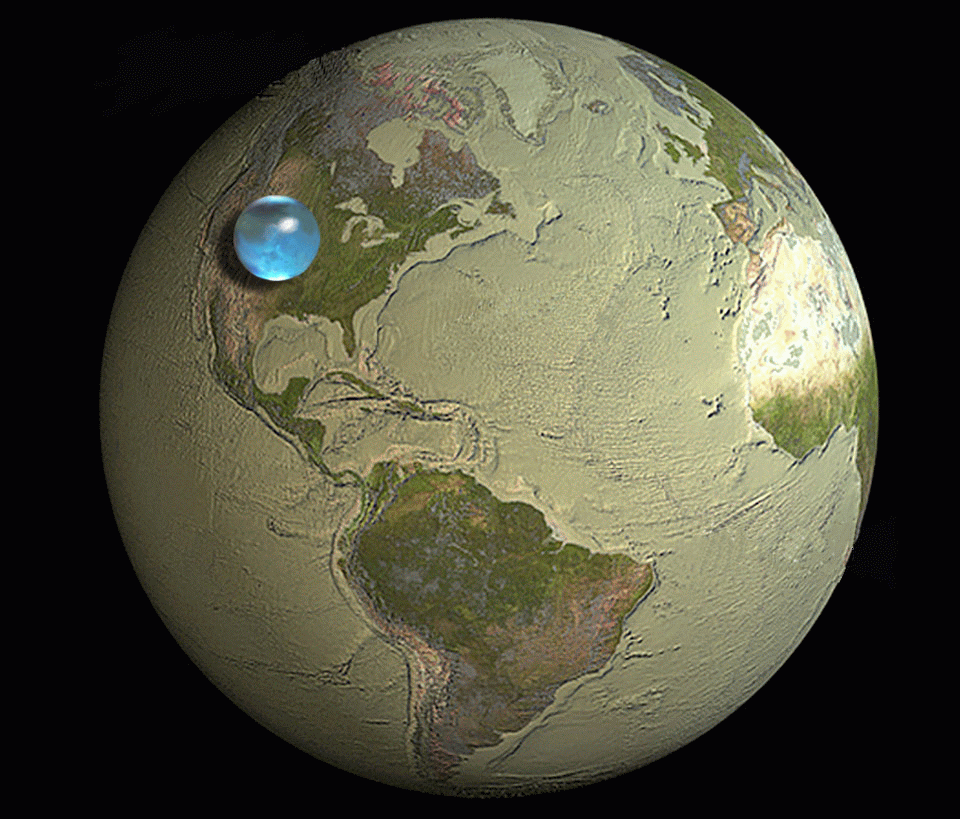 This stunning image brought home for me the preciousness of water.
We believe we are the blue planet, seven-tenths covered in water; and yet all the water collected together from the air, rivers and oceans – the water we depend on – forms this tiny droplet.
You can see the full image here.
For some this image may simply be a representation of known information in a new and surprising way; for others it might be a ‘wake up’ moment’ – in the same way that the Earthrise photograph (taken by the Apollo 11 space crew) has been dubbed the most influential environmental photograph ever taken.
Or do you remember your first reaction to this statistic: if every human being wants to live like western Europeans, we’ll need three planets to provide all the necessary resources and to cope with the waste. And make that five planets if we all want the lifestyle of North Americans.
It is known that information, on its own, is rarely enough to change behaviour. Images and statistics can sometimes help, though, in bringing a message home.
Drink of water, anyone?
 John Gray